Best Litter Box for British Shorthair Cats: What We Use
Best litter box for British Shorthair cats: start with the cat, not the lid
A litter box is not the most glamorous thing we bring into a home, but it has to work every single day. Living with British Shorthairs has taught us that a box can look lovely in a product photo and still be too small, awkward to enter or simply unpopular with the cat who is supposed to use it.
We therefore look first at room to turn, entry height, litter tracking and how easy the box is to keep genuinely clean. Below you will find the standard, stainless-steel and automatic litter boxes we use or have selected for the needs we know well, plus the litter that works in our routine.
The short answer: choose the largest practical box with an entrance your cat can use comfortably. A roomy open or hooded tray keeps things simple, a stainless-steel base is easy to wash, and an automatic litter box is useful when you want less daily scooping and accept the higher price and occasional deep clean.
A quick affiliate note: if you buy through one of our Amazon.de links, we may receive a small commission while your price stays the same. The products are here because they match needs we know from a real multi-cat home, not because a listing calls them perfect.
Which type of cat litter box suits your home?
Type
Often works well for
Main advantage
Check before buying
Open tray
kittens, seniors and cautious cats
easy entry and a clear view of the room
more litter and odour can reach the room
Hooded box
homes where litter tracking is a problem
the hood contains some scattered litter
some cats dislike doors or a cramped entrance
Stainless steel
easy washing and a durable base
smooth surface is simple to maintain
overall size, seams and entry height
Automatic
adult cats and less daily scooping
moves clumps into a waste drawer
price, dimensions, safety limits and deep cleaning
Size and location matter more than a beautiful cover
British Shorthairs are solid cats and many standard trays become tight surprisingly quickly. Your cat should be able to enter, turn and dig without constantly touching the sides. Feline guidelines commonly suggest a box about one and a half times the cat’s length from nose to the base of the tail.
For several cats, one box per cat plus one extra is a useful starting point, placed in separate quiet locations. Boxes should be easy to reach and positioned so one cat cannot block another’s exit. You can read more in the AAHA/AAFP feline guidelines and the AAFP/ISFM house-soiling guidelines.
Standard litter boxes: simple and dependable
A classic tray is easy to understand, clean and replace. Hooded models help us contain some of the litter, but we do not insist on the flap door. If a cat hesitates, we remove it and let her get comfortable with the space first.
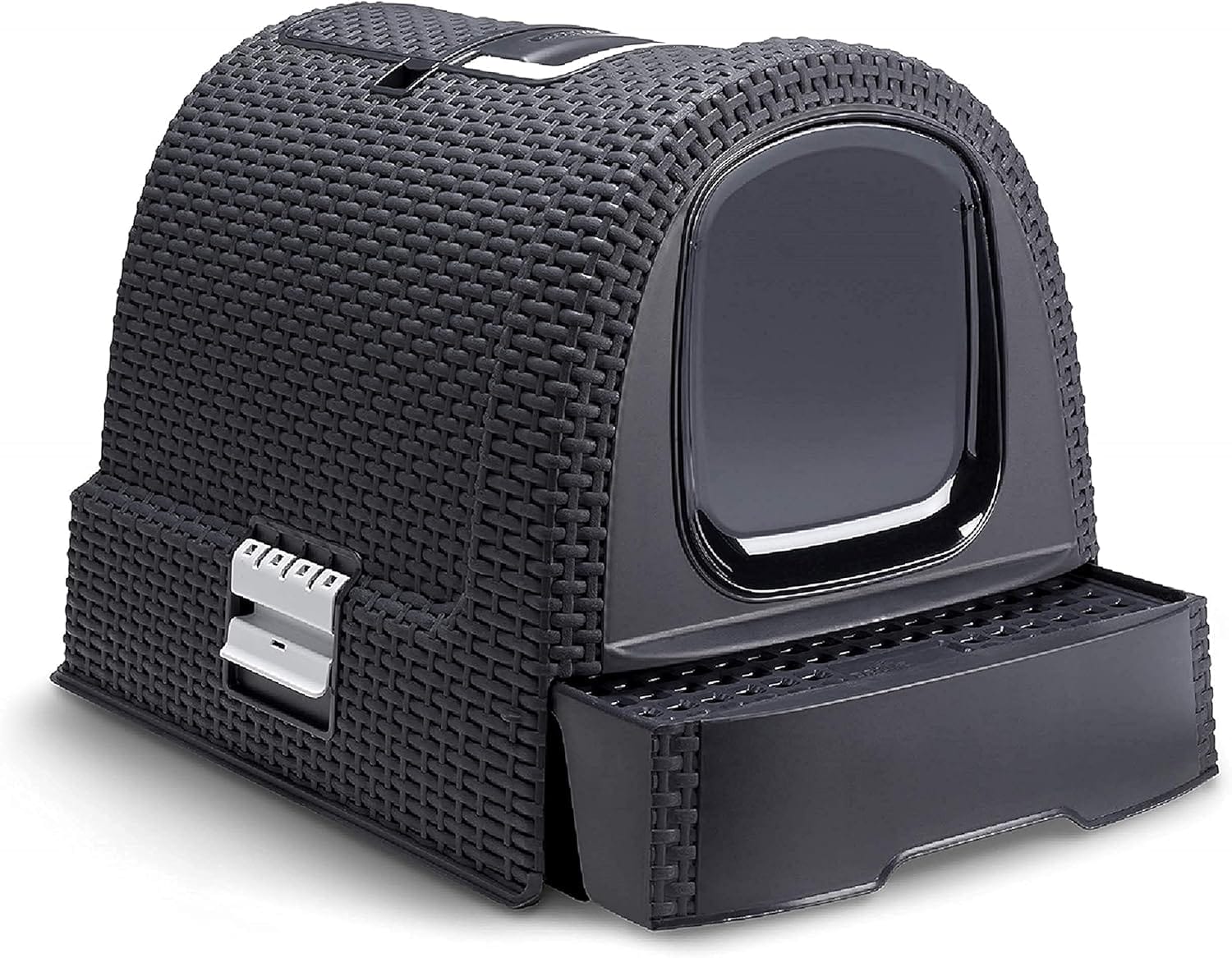
Curver Style V46 Cat Litter Box
Recommended for New OwnersTested in Our Cattery
Curver is practical when we want a hooded box that does not look bulky in the room. The drawer and scoop make daily cleaning easier, and the whole unit comes apart simply when it is time for a thorough wash.
Catit Jumbo is one of the boxes we have used for years. It is roomy and sturdy, while the hood helps contain some scattered litter. The filter may help with odour, but regular scooping remains the most important part.
Stainless-steel litter boxes: an easy-to-wash base
A steel base is smooth and practical for a thorough wash, but the material alone does not make a good litter box. Check the usable dimensions, entry height and the way the upper guard joins the base. For a large cat, room to move still matters more than a modern finish.
Lifewit Cat Litter Tray Stainless Steel with Lid
Recommended for New Owners
Lifewit suits us when we want a roomy tray with a steel base that is simple to wash. The high guard helps with litter scatter and the front entrance stays visible for most adult cats.
Zarler is interesting for larger cats and homes where litter often ends up outside the box. The steel base is easy to maintain and the high sides help keep litter and splashes inside.
Nauotk is another steel-base design that is easy to wash. It includes a mat and scoop, while the high guard helps with litter scatter. Check the exact dimensions because listings with similar names can differ.
Automatic litter boxes: less scooping, not zero work
An automatic box can make everyday life much easier with several adult cats. You still need to empty the drawer, add compatible litter and take the unit apart for an occasional deep clean. Always check the manufacturer’s age and weight limits, entry size and safety instructions.
CATLINK PRO Automatic Cat Litter Tray, Multi-Cat Detection, App Control, Cat Condition Monitoring, 57 L
Our PickUsed Daily
CATLINK is useful in an adult multi-cat home because the app helps us follow usage and the waste drawer. Before buying, check the permitted cat weight, entry height and the exact version being sold.
We use the Oneisall Ease S1 in our cattery and it is currently our first choice among open-top automatic boxes. It gives large cats room and a clear view, and we find it easier to clean than an enclosed globe. Check age and weight limits and whether you are buying the basic or app-connected Pro version.
See the Oneisall Ease S1 in our home: this video shows daily use, cleaning and how it fits into a multi-cat cattery.
How do we choose cat litter?
We want litter that forms firm clumps, is easy to scoop and has no strong added fragrance. Many cats prefer a fine, unscented clumping litter, but every cat has her own habits. When changing type, make the transition gradually and watch which box she chooses.
Scoop at least once a day and more often in a multi-cat home.
A mat in front of the box catches some litter from the paws.
Strong perfumes are not our first choice; a clean box matters more than masking smells.
If a cat suddenly stops using the box or strains to urinate, contact your veterinarian.
Ever Clean Extra Strong Clumping Cat Litter, 10 Litre, Unscented
Our PickUsed DailyRecommended for New Owners
We use unscented Ever Clean because it forms firm clumps that are easy to remove. It works well in our daily routine, but when changing litter always watch what your own cat accepts.
Alongside the Oneisall test above, these videos show CATLINK and PETKIT around our cats, including what we like and what takes more cleaning.
Frequently asked questions
How many litter boxes do two or more cats need?
One per cat plus one extra, in separate locations, is a useful starting point. Even when two cats share happily, another option helps prevent one cat from blocking access.
Is an open or hooded litter box better?
The one your cat uses without hesitation. Open trays offer space and visibility; hooded boxes contain some litter. If the hooded box is avoided, try removing the flap or hood.
What size litter box suits a British Shorthair?
As roomy as practical. The cat should enter, turn and dig without constantly touching the sides. A common guide is about one and a half times her nose-to-tail-base length.
Which cat litter controls odour best?
No litter replaces regular scooping. We prefer an unscented clumping litter that lets us remove the soiled part easily instead of covering smells with perfume.
Can ordinary litter be used in an automatic box?
It depends on the model. Some need clumping litter of a specific grain size and do not work well with pellets or very light materials. Follow the instructions for the exact unit.
What if a cat suddenly toilets outside the box?
Do not assume she is being difficult. Check cleanliness, access, location and household changes, and speak to your veterinarian because a sudden change can have a medical cause.
In our home the best solution is always practical: enough room, a quiet location and litter the cat accepts are worth more than a long list of features.
We use cookies on our website to give you the most relevant experience by remembering your preferences and repeat visits. By clicking “Accept All”, you consent to the use of ALL the cookies. However, you may visit "Cookie Settings" to provide a controlled consent.
This website uses cookies to improve your experience while you navigate through the website. Out of these, the cookies that are categorized as necessary are stored on your browser as they are essential for the working of basic functionalities of the website. We also use third-party cookies that help us analyze and understand how you use this website. These cookies will be stored in your browser only with your consent. You also have the option to opt-out of these cookies. But opting out of some of these cookies may affect your browsing experience.